SWISS SNOW IN THE SUMMER

Snowing in the Swiss Alps in summer time - snow on the buttercups and wild flowers

SHENANIGANS

1. secret maneuvering

2. high-spirited activity

derivation : Irish expression sionnachuighim - "I play the fox"


It was the middle of June, and the Summer blizzard came upon us quite unexpectedly. It seems to be the way of nature, to whip up one's plans with the wind, scattering them to the four corners, and then to reveal upon the weary traveler many unlooked for experiences of great beauty. 

And so it was that day - we had intended to hike the flowered mountains under an endless blue sky, but our reality became so much more than that: a limb-numbing cold, and swirls of snowflakes creating a hide-and-seek game with the landscape. One moment of visibility unveils a waterfall, rampaging through rocks and pine trees, another moment hides the scene behind a grey mist that falls into oblivion below. It instilled a kind of laughable joy in me, to see the spring flowers dusted with snow, and to think that we were so lucky as to see this anomalous weather.


SYMBOLISM | SNOW IN SUMMER

Snow and frost will bring an end to plant life, but from the white ashes of winter, a new world is born, and thus snow can be seen as a purification - a cleaning out of the old year and ushering in the new. Spring snow, too, represents that new life, and new beginnings. But snow in summer is something else. It is a mischief of the skies, an unexpected moment. Each flake meeting the green land in a blessing from above.


A fox trotting through the Swiss Alps in the snow in summertime.


And then, entering the path ahead of us, was a fox. She seemed unperturbed by our closeness. So agile and ethereal - like a wisp of a dream, I watched her till she disappeared into the white veil of the weather. Had I not taken a picture, I might have believed the whole thing to be a hallucination, brought on by the rising cold in my uncovered legs and arms. 


SYMBOLISM | THE FOX

The fox has always been a symbol of mystery - of the wilderness untamed. Of hidden things and subtlety, and the ability to hide oneself. Of feminine energies, and the wisdom of one's own counsel.

Certain groups of Native American warriors would wear a fox skin, the head of the fox covering their own, so as to imbibe the wisdom of the animal in all its secrecy and cunning. Druids of the north would name their elders 'Son of the Fox', also pointing to the animal's mystical wisdom.

Bringers of change, the fox is a shapeshifter and has long been aligned with the energies of the earth - of constant change. When the spring snow was melting, people would watch the fox to see whether it would walk on the melting ice. If so, the ice was safe to cross. 

Thus, the fox may be seen as a guide, a teacher, a way-finder, and a messenger between ourselves and the wild world.


In ancient Sumerian mythology, the fox was a messenger of the goddess Ninhursag, she who dwelt in the mountains. Ninhursag, the mother goddess, who asked Enki to create the waters of the world, and from those waters, gave birth to all plant life in the form of the goddess Ninsar, who walked in the Middle World and gave life to all of it. 

It was the fox who, upon hearing of Enki's illness - which he brought upon himself through greed and consumption and ill use of the earth's plant life, it was that fox who resolved to find Ninhursag and to ask her to heal the sick god, and to heal the earth.

Looking back, I now feel so blessed that this fox wished to reveal herself to me in the mountains of Switzerland.

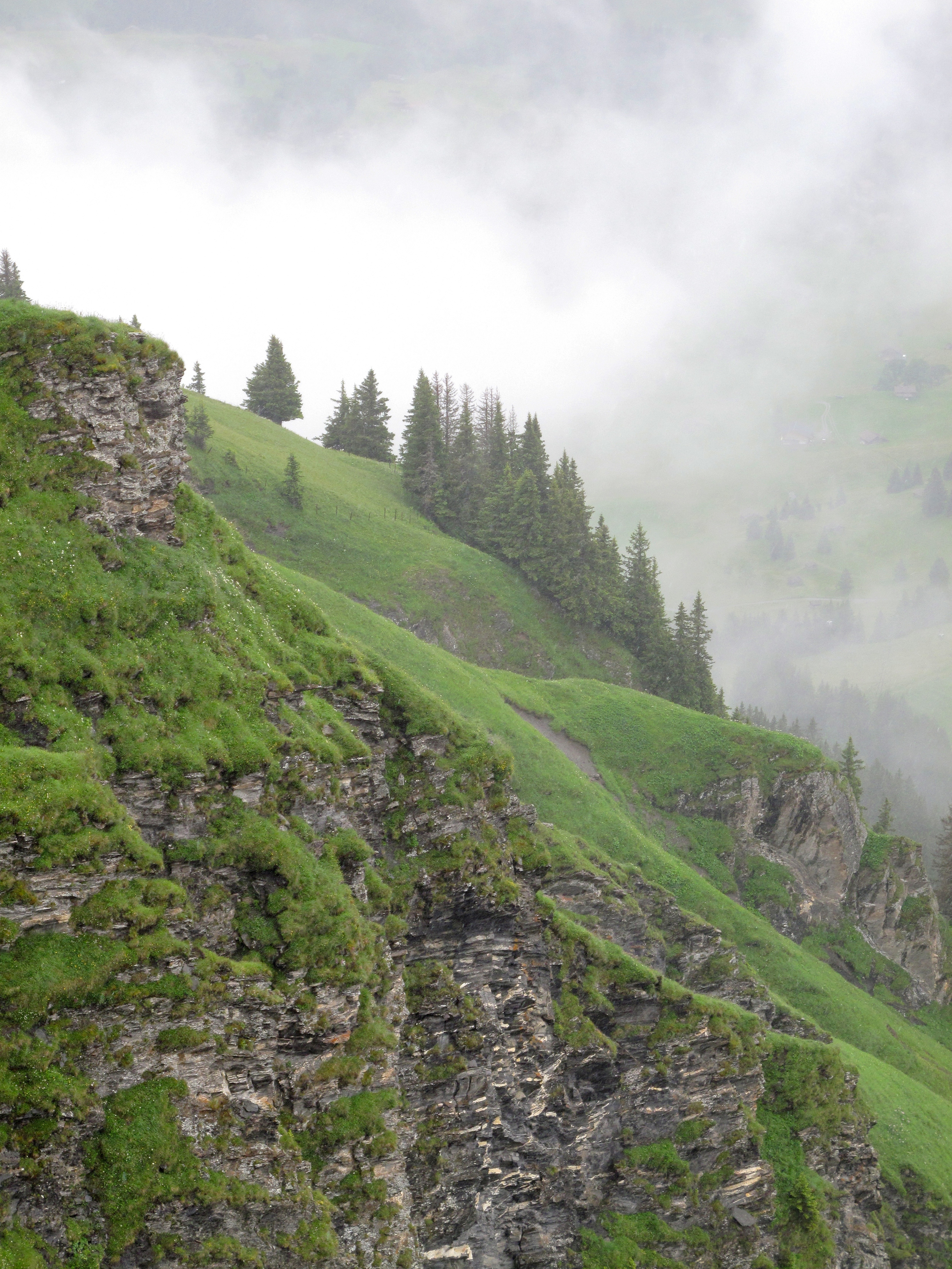
 

Snow on purple flowers in the Swiss Alps.
The Swiss Alps in summer time where it is still snowing on the green grass of the mountains and the pine trees.
Waterfalls high up in the Swiss Alps near Lauterbrunnen
A snowy landscape up in the mountains of Switzerland, with a small stream running through it.

LAUTERBRUNNEN

Waterfall in the Lauterbrunnen Valley, Switzerland

INTO RIVENDELL


EXCERPTS FROM LETTER 306.

By J. R. R. Tolkien to Michael Tolkien, c. 1967


I am delighted that you have made the acquaintance of Switzerland, and of the very part that I once knew best and which had the deepest effect on me. Bilbo's journey from Rivendell to the other side of the Misty Mountains, including the glissade down the slithering stones into the pine woods, is based on my adventures in 1911...

Our wanderings mainly on foot in a party of 12 are not now clear in sequence, but leave many vivid pictures as clear as yesterday (that is as clear as an old man's remoter memories become). We went on foot carrying great packs practically all the way from Interlaken, mainly by mountain paths, to Lauterbrunnen and so to Mürren....

I left the view of the Jungfrau with deep regret: eternal snow, etched as it seemed against eternal sunshine, and the Silberhorn sharp against dark blue: the Silvertine (Celebdil) of my dreams.


The Lauterbrunnen Valley, Switzerland - a green valley bordered by high mountains


EXCERPTS FROM THE HOBBIT

by J. R. R. Tolkien, 1937.

"Here it is at last!" he called, and the others gathered round him and looked over the edge. They saw a valley far below. They could hear the voice of hurrying water in a rocky bed at the bottom; the scent of trees was in the air; and there was a light on the valley-side across the water.

Bilbo never forgot the way they slithered and slipped in the dusk down the steep zig-zag path into the secret valley of Rivendell. The air grew warmer as they got lower, and the smell of the pine-trees made him drowsy, so that every now and again he nodded and nearly fell off, or bumped his nose on the pony's neck. Their spirits rose as they went down and down. The trees changed to beech and oak, and there was a comfortable feeling in the twilight. The last green had almost faded out of the grass, when they came at length to an open glade not far above the banks of the stream. 

... And so at last they all came to the Last Homely House, and found its doors flung wide.


Swiss chocolates in the bath
Lauterbrunnen wooden houses and hotels and hanging geraniums
A little swiss chalet and a pink flower in the mountains of switzerland
Swiss cider
Pink flowers and a wooden chalet in Switzerland's Lauterbrunnen Valley
Geschnetzletes mushroom sauce with noodles in Switzerland
The Swiss Alpes on either side of the Lauterbrunnen Valley
A lake and a small village in Switzerland
In the mountains of switzerland, with white flowers and small chalets.

ANNECY

Turqouise canals and flowers in Annecy, France

A TOWN OF WATERS

The town was built around the waters that flowed from the lake in two streams. 

It had always been a place of settlement, as far back as memory holds, but it was around 1107 that the town of Annecy began to flourish, nourished by the lake and the rivers. It was water that the people were drawn by. It was water - the birther and the protector, that brought this town to life. Water provided for the survival of inhabitants in the early days, and later - with the construction of the castle on the island in the middle of the town, it provided protection. Later still, the waters of those two rivers fed the watermills of the workshops that sprouted on the outskirts of that medieval village: the blacksmiths, and the textile mills. Water brought movement to the town, large boats with triangular sails bringing supplies, or smaller personal crafts moving about the stone streets, with doors opening onto the canals themselves. Water brought culture too - as the marshes by the riverside and the pastures on the lakeside began to be converted to parklands and woodlands, perfect places for the reflecting thoughts of walkers. 


Reflections of the mind : glimmering shadows caught between moving surface and shifting sands, hinting at a further notion: 
something unseen.


Water is the giver of life, it is the deep sea before sight, the eternal womb from which our human lives, and indeed all other lives emanate. It is the mystery too, the unknown darkness beneath us and within us, within our psyches. It is the collective pool of the unconscious, and also the moving tides within our veins, it is the swirling life force behind each being - it is our 60 percent; over half of our being is composed of it. Water itself may be able to contain emotion and intention, within its very molecules.

Who has not known the longing, the footsteps that take us lakeside or riverside to contemplate life? We are all drawn to bodies of water, to stabilise our own thoughts and plug back into the wider energy systems that surround that body. When we build towns and cities and lives that are divorced from water, we cut ourselves off from one of the most important elements to life itself, and we begin to undervalue its importance in everything - sometimes to such an extent that we will allow pollutants into our waters. But when we refocus, realising the sacred nature of water, we might find in ourselves a desire to preserve our aquatic environments. For we depend on them.

The town of Annecy instills a calm feeling in the viewer. Standing on the Pont des Amours, a fine example of a Belle Epoque iron-cast bridge, and watching the swans drift about, I felt an immanence and a transcendence - a kind of peace. The swans floated as if on air, graceful clouds casting shadows on underwater valleys of weeds, with only a hint of green-blue caught in between.


Lamp post and a bridge covered in flowers on the canals of Annecy le Vieux
Annecy's beautiful canals and old buildings in Annecy le Vieux - with flowers in the summer
A small dinghy boat in the private canals of Annecy, with reflections of leaves on the water.
A swan on the canals of Annecy, in Summer time.
French cheeses at the market in Vieux Annecy
Boats on Lake Annecy in the summer - the water is completely clear and turquoise coloured
The sea always signifies a collecting-place where all psychic life originates, i.e., the collective unconscious. Water in motion means something like the stream of life, or the energy-potential.
— CARL JUNG, 1935
A white swan on the clear waters of lake Annecy
Baby birds swimming in Lake Annecy