THE HILLTOP TOWNS OF ANDALUSIA

Hilltop towns in the mountains of Andulacia, Spain

GOATS, CARPETS & CHIMNEYS

In the hill-top towns that crown the mountains in the Kingdom of Spain, the villagers live rich lives of quietude, interrupted only by the occasional festival. 


SMALL WONDERS OF THE MOUNTAINS

The overwhelming joy in my heart when we entered the mountains - like a feeling of coming home. I was finally able to see further, breath deeper and take in all that blue sky.
That day was like a cat, asleep in the sun: warm, and relaxed.
A teensy Catholic shrine, the gate laden with roses, prayer beads and ceramic figurines.
The many orange sellers, sat by the roadside with bags of oranges piled high on the bonnet and sides of their cars.
A beer in the gardens of Casa de Pilary Paco Lopez.
The abundance of prickly pears that grew on the cacti, up there in the high places.
The whitewash and the clay chimneys on the small mountain houses. Each one reflecting the glare of sun, making the villages gleam from afar.
The insistence of the carpet sellers.
A shepherd tending a flock of goats with bells on.
The complete silence that descended at the Siesta hour. The only sound is the flap, flap of a woven curtain hanging in a doorway.
A little wooden door, charming beyond belief. Behind it: Pepe the Jamón seller, who proceeds to show me how to carve a giant leg of ham.
A circle of elder villagers watching a young boy kick a deflated soccer ball. 
In a courtyard lined with lavender bushes, a small fountain trickled water - just one of the many fountains that flow with medicinal spring waters in the area.
Purveyor of fine spanish mountain wares - carpets and painted chairs
Person selling oranges from the hood of their car, in the mountains of Andulacia
Shop in the Spanish mountains selling jamon, honey, herbs and chillies
carpet door hanging and white walls and siesta time in the Spanish mountains
Fountain of healing in the Spanish mountains
Little rustic wooden door in a tiny mountain town
prickly pear on a cactus in the Spanish mountains

CÓRDOBA

Date trees and white walled buildings
The test of a first-rate intelligence is the ability to hold two opposed ideas in the mind at the same time, and still retain the ability to function.
— F. Scott Fitzgerald
ONCE UPON A TIME IN THE MID-EIGHTH CENTURY, AN INTREPID young man named Abd al-Rahman abandoned his home in Damascus, the Near-Eastern heartland of Islam, and set out across the North African desert in search of a place of refuge. Damascus had become a slaughterhouse for his family, the ruling Umayyads, who had first led the Muslims out of the desert of Arabia into the high cultures of the Fertile Crescent. With the exception of Abd al-Rahman, the Umayyads were eradicated by the rival Abbasids, who seized control of the great empire called the 'House of Islam.' This sole survivor was too young - he was in his late teens or early twenties - to be terrified at the odds against him, nor was his flight westward, towards what was the farthest frontier of the Islamic territories, as arbitrary or hopeless as it may have seemed. 
Abd al-Rahman followed his ancestors trail and crossed the narrow strait at the western edge of the world. In Iberia, a place they were calling al-Andalus... he found a thriving and expansive Islamic settlement. Its centre was on the banks of a river that wound down to the Atlantic coast. The new capital was an old city that the former rulers, the Visigoths, had called Khordoba, after the Roman Corduba, who had ruled the city before the Germanic conquest. It was now pronounced Qurtuba, in the new Arabic accents heard nearly everywhere.
With Abd al-Rahman's arrival in 755, the fate of the House of Umayya was no longer a distant and abstract matter but the centre of local political turmoil. The wild turn of events, and its consequences, can perhaps only be imagined by conjuring the image of Anastasia, and what might have if she really had reappeared one day in Paris and unambiguously claimed the survival of the Romanovs. Abd al-Rahman was in some ways the quintessential Arab, the heir and descendent of the desert warriors who were the companions of the Prophet himself... This made it easy for him to claim the loyalty of the soldiers and settlers in this promising and fertile new land. The vexed emir of al-Andalus saw at least some of the handwriting on the wall and offered the young man permanent refuge in the capital city, as well as his daughter's hand in marriage. But the grandson of the caliph, the successor to the Prophet, and the supreme temporal and spiritual leader of the Islamic world, could not be so easily bought-off. 
Abd al-Rahman assembled forces loyal to him... and one day in May 756, a battle outside the city walls of Cordoba decisively changed the face of European history and culture. Abd al-Rahman easily defeated his would-be father-in-law and became the new governor of this westernmost province of the Islamic world.

- Extracts from The Ornament of the World - by María Rosa Menocal

Exotic trees and castles at Cordoba, Spain

AFTER HE HAD GAINED POWER IN CORDOBA, PRINCE Abd al-Rahman proceeded to establish control over almost all of the Iberian peninsula. But in Cordoba itself, he focused his efforts on recreating all the grandeur of Damascus, his former home.

The new prince sponsored all kinds of artistic and architectural ventures, promoted agriculture, and, among other things, bought an old church from the local Christians with the intent of turning the site into a vast Mosque. Al-Andalus was about to enter what many would call the Islamic Golden Age.


A MULTI RELIGIOUS SOCIETY

The incredible beauty of the works that were produced in al-Andalus (what we now call Andulasia), is owed in part to the unique multicultural and multi-religious society that was living in the area at the time. 

Whilst Islam remained the ruling religion, Christianity and Judaism were also tolerated. Christians and Jews were, for the most part, respected under Islamic law as dhimmis - People of the Book, and were thus protected. And smaller factions within each group also cooperated  - Berber muslims lived alongside Arabs and Mullawads; native Iberian Christians mingled with Hispano Romans and the descendants of the Visigoths; and the Jews that had long been persecuted under the Visigothic rule, were now integrated into Islamic culture and politics, some holding influential positions in the Umayyad bureaucracy. Christian and Jewish doctors, architects and philosophers were all able to flourish under the Umayyad rulers.

Scholars may still argue over the amount of tolerance that was present in this golden age society, but none would argue the fact that this intermingling of faiths and ethnicities provided a rich environment for Andalusian arts.


Horses and carriages in Spain
jumbled rubble of old buildings and walls in Cordoba
Date trees in Spain, dropping dates on the ground.

A CATHEDRAL & A MOSQUE


A ray of light coming through a window in the Cathedral of Córdoba
 

In so many ways, the old Cathedral of Cordoba acts as a tangible representation of the society in which it was built. A church encased in a mosque - two opposing ideas held inside one large entity... 

The details themselves are reminiscent of a time when multiculturalism was the norm, before the pogroms and inquisitions of the Reconquista. The pillars of the mosque are an eclectic mix - some salvaged from roman ruins, some carved by Muslim architects, who would initial their own work.

Even after the Reconquista, the resurgence of Christianity, and the implanting of that Cathedral within the confines of the old Mosque, the effects of an intermingled society lived on in Andalusian art and architecture. A hybridized style began to form in this area, called Mozarabic art. While Arabic Islamic art was typically limited to the depiction of patterns and geometries, and the typical Catholic art of the time depicted allegorical scenes of people, animals and plants, the art of Andalusia shows a combination of both these aspects, with the incorporation of flowers into Arabic patterns, and the exemption of exterior decorations in churches and synagogues. 

 
Mosque of Córdoba in Spain - painted pillars as far as the eye can see
Ceiling of the Cathedral of Córdoba
Carvings of St Raphael in the Cathedral of Córdoba
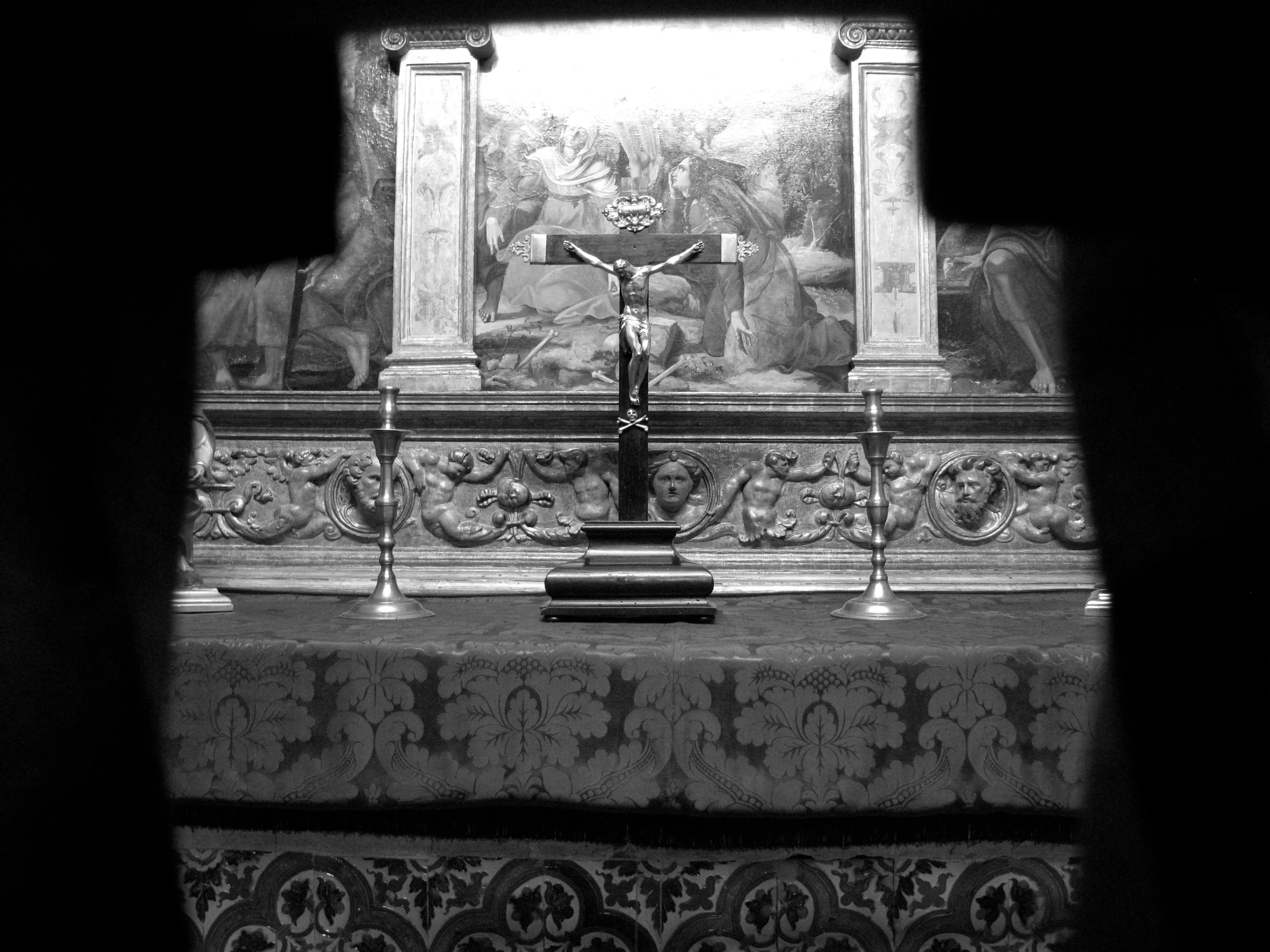
small closed chapels of Córdoba, with golden figures of Christ
Name of the pillar maker inscribed on the pillar, in the mosque of Córdoba
Cathedral of Córdoba - the Christian part of the cathedral, with rich decoration

SMALL WONDERS OF CÓRDOBA


INSIDE THE MOSQUE AND CATHEDRAL

The realisation of the immense SPACE that is the old mosque -a feeling magnified by the repeating geometry of the columns and two-tiered symmetrical arches.
Inspecting a small inscription - a carving of initials done by a Muslim architect a millennium or more before I was even born. A sign of the humanity of the past.
The light that filtered through the high windows, narrowed into a perfect beam as if caught by a prism.
Peeking through a keyhole in an old wooden door, and spying a golden figure of Jesus on the cross, laid carefully in the middle of a table of red silk. 
Losing sight of my uncle and aunt among the pillars, becoming lost myself, and catching eery glimpses of figures shifting between the shadows. 
The fact that the olive tree in the courtyard dates from the eighteenth century.


OUTSIDE IN THE CITY ITSELF

Fallen oranges collected in buckets under the topiary-like trees.
Dogs roaming freely on the streets.
Church bells ringing at dawn.
Hundreds of hidden courtyards, each one a garden. Some with fountains, others with walls of trailing plants.
The bare painted walls of a Jewish synagogue, uncovered after centuries of overlaying façades.
The sound of fresh dates falling on the dusty ground, from towering palm trees.
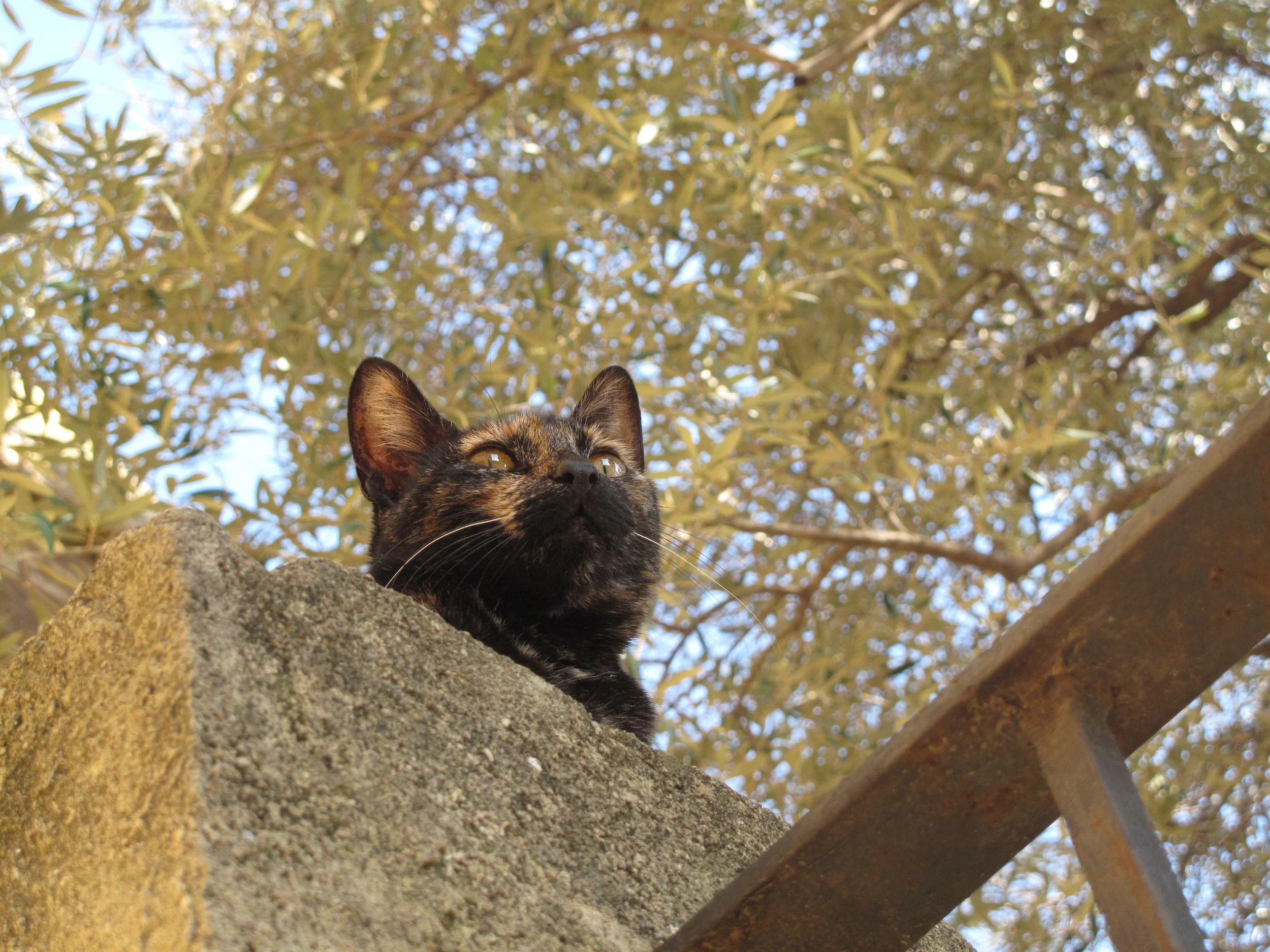
A cat with green eyes at the castle.

View of the lake from the tower of the Alcazar, Córdoba
A green eyed tortoiseshell cat sitting on a wall at the castle
Fish in a green lake with reflections of date trees
Castle of Alcazar - pool and crenellated walls
Medieval hand painted family crest on a wall at the Alcazar - of lions and castles
Marigolds at the Alcazar

THE ALHAMBRA

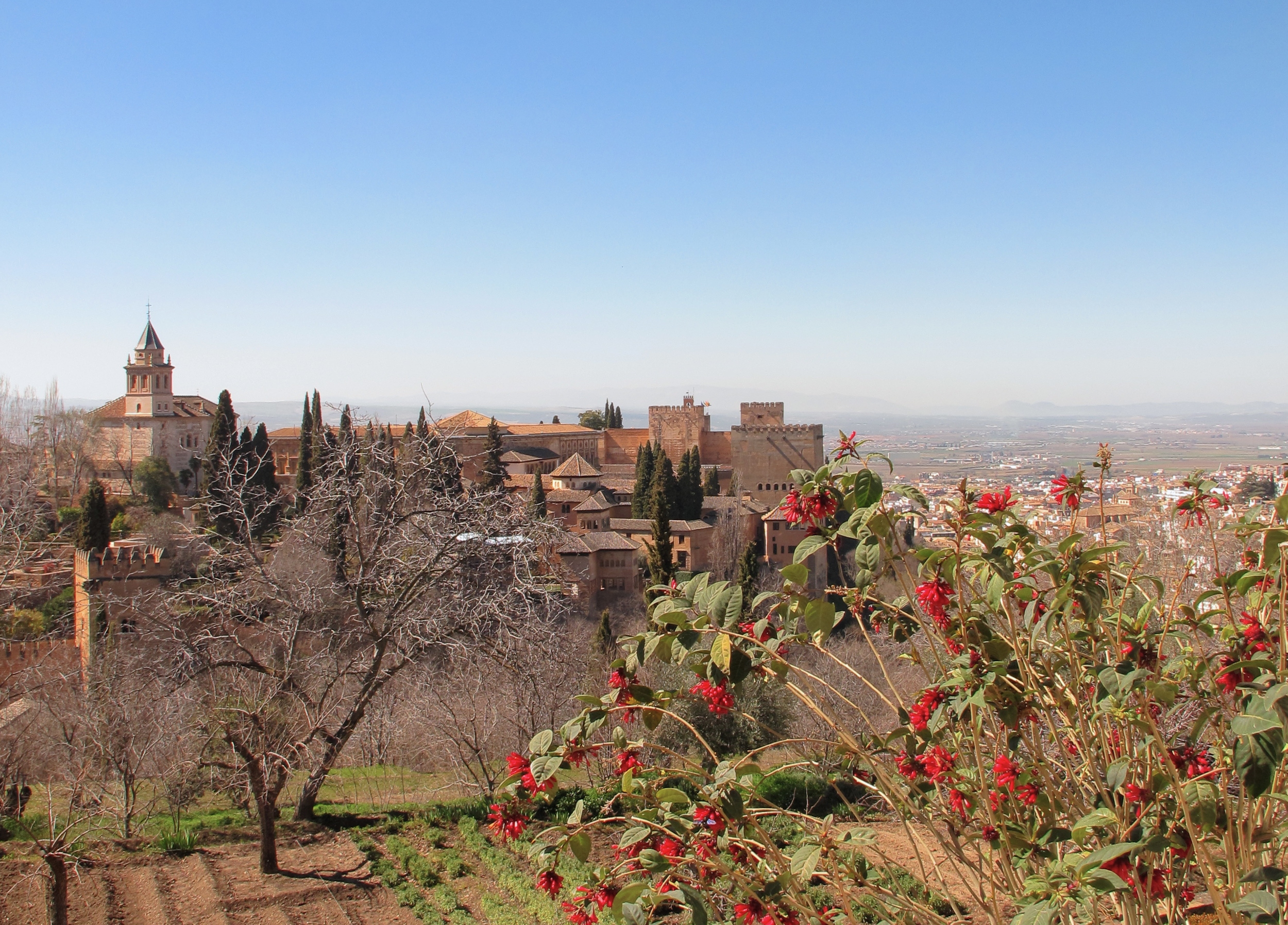
The alhambra - medieval muslim castles under a blue sky

A STUDY OF PATTERNS


THE STUDY OF GEOMETRY 

The House of Wisdom was set up in Baghdad c. 810.

Scholars from all over the empire came to this center of learning to translate classical Greek and Indian documents, and in the process a new era of scholarship was begun, as they added their own discoveries and wisdom to the old texts. 

Some of the most important ideas to come out of the middle ages originated in this period of Islamic scholarship. For instance, Muhammad Al-Khwarizmi, in expanding on the Hindu concepts of the numbers zero through nine, introduced the fundamental algebraic methods of balance and reduction - thus giving us a general tool to solve abstract problems, rather than the very specific ones previously set out by Indian philosophers.

But perhaps one of the most interesting advancements to the classical texts was in the study of geometry. Ancient texts by Euclid, Archimedes and Apollonio were translated and then developed upon until wholly original ideas were discovered. For example, Ibrahim ibn Sinan developed the Greek methods for drawing the parabola, ellipse and hyperbola, and used his innovations to construct a more advanced sundial. 


THE ART OF GEOMETRY

Just as the seeds of ancient texts were watered by the scholarship of the Islamic world, and began to bloom into (highly geometric) flowers; so the seeds of those flowers began to pollinate the realm of the arts, and of architecture.

The writings of one geometer - Nasr al-Farabi - were highly influential in the art world, and slowly but surely, geometry found its niche: on the walls of buildings. 


SACRED GEOMETRY

Among other things, the Quran prohibits the artistic depiction of humans and animals, in order that the devout will not be awed by fake idols, nor will they rival God in his role as creator.

Such limitations surely made the lives of artists and medieval interior decorators that much more difficult, but one could say that this philosophy provided an impetus for the creation of new decorative forms.

In particular, three special forms of decoration were developed, and together they formed an ornamental canon of sorts.

First, the most noble of the arts - calligraphy, and the transcription of sacred texts onto walls and objects.
Second, the depiction of vegetal designs, with their origins in nature. Twisting vines and leaves, curlicues and flower patterns, these were developed early on and became part of the 'arabesque' tradition.
And third, the translation of geometries into patterns. Geometry always held an appeal to Islamic artists, as it provided a subject matter that avoided any religious offense, while also representing a variety of Islamic ideas.


These geometric patterns had their origins in the circles, hexagons, triangles, squares and dodecagons of classical theorists. And yet, in Islamic art, the shapes became so much more complex, as each was interwoven onto the next in matrices of never ending symmetry and repetition.

Islamic ornamentation usually opted for a-centric arrangements in patterning, avoiding obvious focal points – a preference that resonates with the Islamic perception of the Absolute as an influence that is not ‘centered’ in a divine manifestation (as in Christianity), but whose presence is an even and pervasive force throughout the Creation. A further analogy can be drawn between the patiently created repeats of the ‘infinite’ pattern... In an Islamic context, repetition is not tedious; on the contrary, it connects to the world of the spirit.
— David Wade, Pattern in Islamic Art

In fact, by using geometric patterns, Islamic artists were able to evoke many complex thoughts and feelings within the viewer. Looking upwards at a dome decorated with five-fold motifs, one may be reminded of the cyclical movement of the planets, which Plato called the 'music of the spheres.' Similarly, stucco and plaster moldings of interlinking 10-fold rosettes could remind the viewer of the incredible beauty of flowers, and the miracle of symmetry in nature.

The origin of the word ‘cosmos’ is adornment (from which we derive the modern word ‘cosmetics’) and the adornment of sacred buildings with both floral and geometric patterns makes the viewer sensitive to the subtle harmonies uniting the natural world around us with the cosmos.
— David Wade, Pattern in Islamic Art
Light pouring through islamic style carvings and windows at the Alhambra
A small bird sitting in a carved door
geometric and organic shapes carved into plaster at the Alhambra

PATTERNS AT THE ALHAMBRA

Inside this Islamic Palace City, built over the course of centuries, there is a wealth of geometric patterns.

The economical wooden walls of the giant superstructure are hidden behind a myriad of plaster dreams - vegetal motifs of scallops and flowers rest between intricate carvings of stars and knots. The painted tiles of one wall meld with that of another, and the ceilings echo those walls with their stalactite structures called mocárabes: honeycomb-like, and incredibly complex concave patterns that carry on in the undersides of arched doorways. It is as if every edifice is carven or worked upon, till the substantial elements of the buildings are dissolved into pattern and lightness. 

Along with the ever-near noises of bubbling fountains, and the flow of the spaces - inner mingled with outer: windows onto courtyards filled with light and orange trees, it seems as if one has entered a version of paradise.

The overall effect is truly transcendent.


Courtyard filled with greenery and a fountain at the Alhambra
Tiled patterns on the walls - green and brown and white
Carved wall patterns in the Alhambra - stunning and technically amazing!
An example of medieval woodwork and painting - geometric shapes at the Alhambra
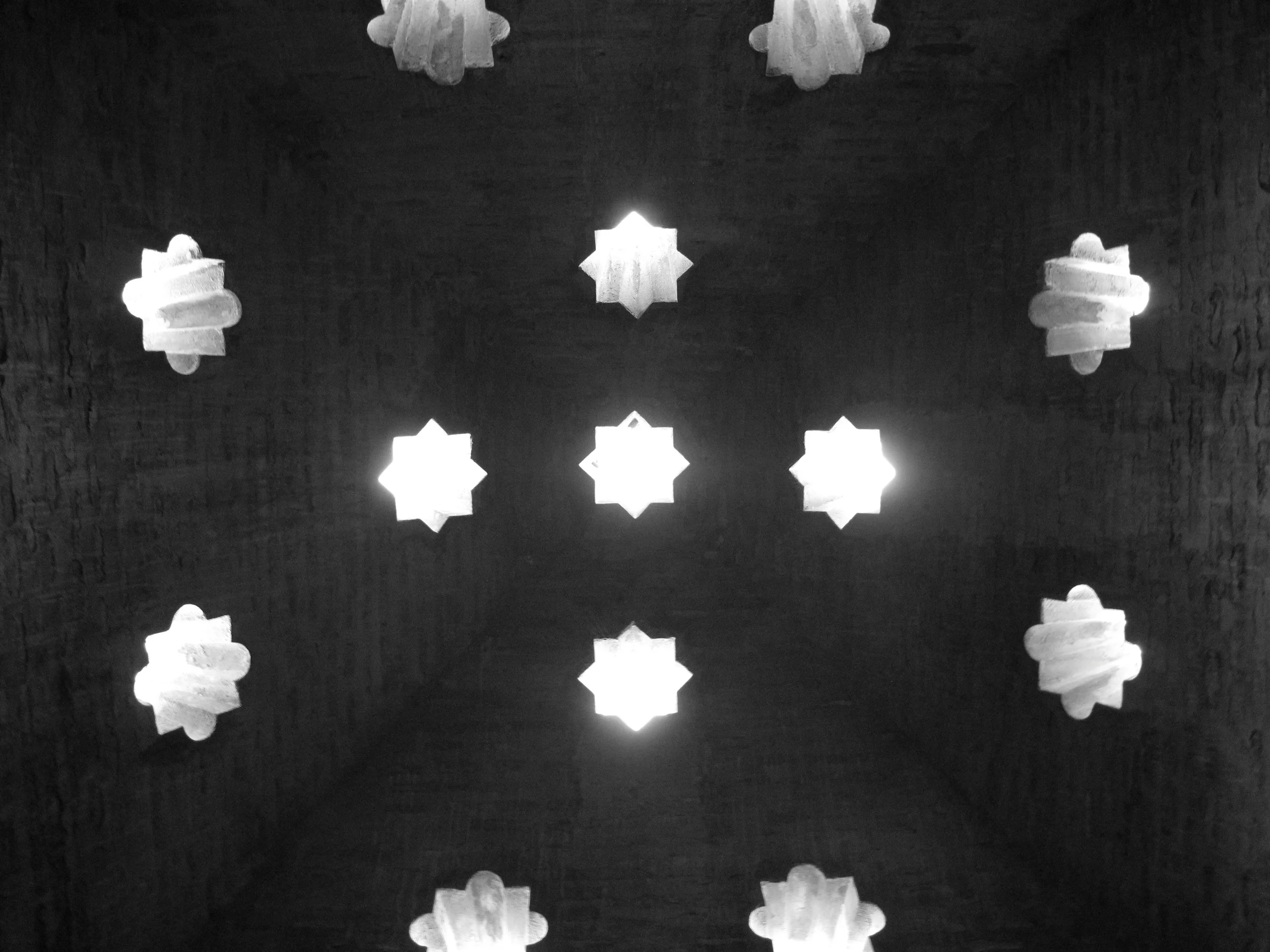
star shaped holes in ceiling of a medieval bath-house, in the Alhambra
Banisters flecked with gold paint
Pigeon bathing in a fountain in the reflecting pool at Alhambra
medieval coloured tile in a pattern
a geometric pattern in the tiles of the Alhambra
Geometry in the wooden roofs of the Alhambra - gold and wood and stars and circles
Circular courtyard of Charles V palace at Alhambra
red, black and white cat hiding under a stone bench.
Windows with traceries at the Alhambra, shadows and light in patterns on the wall
Sun stars through the crenellations of the castle at Alhambra
colourful Spanish flags flying in the breeze and blue sky
Red flowers in the Alhambra gardens
Pink and red flowers in the garden of Alhambra
View of the Alhambra in spring with red flowers

REFERENCES AND FURTHER READING:

- Wade, David. Pattern in Islamic Art. 2006.

- Yahya, Abdullahi. Evolution of Islamic Geometric Patterns. 2013.

- artofislamicpattern.com