ALPINE FLOWERS

Mountains and purple subalpine larkspur flowers beneath an aspen forest.


ON THE IMPORTANCE OF FLOWERS

- an interview with Pamela Soltis

"Currently the angiosperms are by far the largest group of plants and the most important from an ecological standpoint. They inhabit all sorts of environments. They make up the majority of a lot of different habitats, such as grasslands (all the grasses are flowering plants), most forests except for the boreal forests, and most terrestrial habitats on the face of the planet. They provide food sources and shelters for the organisms that live in these habitats. On a more personal note to humans, they provide us with most of our food and, in certain areas, a lot of our shelter materials."


ON GRATITUDE


Brenda takes with her a small bag woven in rich patterns, filled with ground millet, following traditions passed down to her in knowledge. When she comes to a place that she feels is special, she dips her hand into the bag and scatters the millet with a message of gratitude, giving thanks to the environment in her own way.

I have felt incredibly thankful, while walking in the wild woods of Colorado. I have seen all manner of plants, waterfalls, dead trees surrounded by the creeping vines of new growth, and tiny animals. I have dipped my hands into water, my feet too, letting my gratitude take off downstream like a ribbon caught in a flood. 

I will be eternally grateful to the Earth for her generosity, and not least of all, for the wildflowers.


columbine

alpine aster

red desert paintbrush

purple mustard

penstemon

alpine buttercups

chiming bells

clover

creeping thistle

subalpine larkspur

marsh marigolds

subalpine paintbrush

fairy slipper

silvery lupine

catnip

 
Booth Creek Falls Trail in Spring.
Alpine flowers in the mountains of Colorado, Booth Creek Falls in Spring.
Ranunculus Ficaria - a bright yellow many petaled alpine buttercup.
Shrine Pass Trail.
Wild red and yellow columbines in an alpine environment. 
Curvy aspen boles in a forest.
Walking barefoot on the trail.
Wild clover and alpine buttercups
Shrine Pass trail in Spring.
Subalpine paintbrush - purple alpine flowers.

The way of the priestess is not easy, for you must die a thousand deaths to be one with the Goddess - she who flowers ten thousand times.
— SARAH DREW

Desert paintbrush flowers, Shrine Pass, Colorado.
Desert paintbrush flowers in a field of Shrine Pass.
Mertensia Chiming Bell flowers.
Mertensia Chiming Bell flowers, alpine environment.
Marsh Marigold - alpine flowers
Small stream and Marsh Marigolds, Shrine Pass.
Giving thanks to the water.
Ranunculus Alpestris - white alpine buttercups.
Clouds reflected in a pond, in the mountains of Colorado.
Flower shadows on a mossy rock.
Booth Creek Falls, Colorado. 
Chipmunk in the underbrush. 
Alpine Aster purple daisies and red Desert Paintbrush flowers.

SOURCES AND FURTHER READING:


www.actionbioscience.org - interview with Pamela Soltis


ICE GROTTOS

Ice formations in the Grottos of Independence Pass, Colorado.

GROTTO

noun | /ˈɡrädō/

A small cavern scooped into a cave wall, usually by erosion, is called a grotto. The term vaguely suggests protection, shelter or sustenance. As a river term, grotto usually refers to a small, shaded hollow at the foot of a cliff that, most often, leads back to a hidden spring or rivulet.
— ARTHUR SZE - HOME GROUND, LANGUAGE FOR AN AMERICAN LANDSCAPE

ELEMENTS & TEMPORAL CYCLES
 

---
 

One and a half billion years ago,
magma cooled


structuring
[verb: to arrange | 1. the arrangement between parts of something complex]


 a bed
of quartz monzonite
fire -> rock
glittering boudoir undisturbed
 

---
 

15,ooo years ago,
the glacier began to melt
sending its waters


coursing
[verb: to pursue | 1. the sport of hunting game animals]


boulders and sediments


scouring
[verb: move rapidly | 1. to clean or brighten something by rubbing it hard | 2. to subject a place to thorough invesitagation in order to locate something]


into the rock bed
ice -> water
 

---
 

Water is a pilgrim
in the night
searching for a place
to rest
 

---
 

One month ago,
my breath caught in the chambers
cooled to clouds
when the outside world ran rivulets
under a hot sun


water stays here
rests a while
as ice
but will move on
when spring knocks
on the door of rocks

water -> ice
 

---
 

It is exquisite to observe
the way a billion-year-old-rock


cradles
[noun & verb: to hold | 1. the bed of an infant | 2. to hold protectively]


something as ephemeral
as seasonal ice
 

---


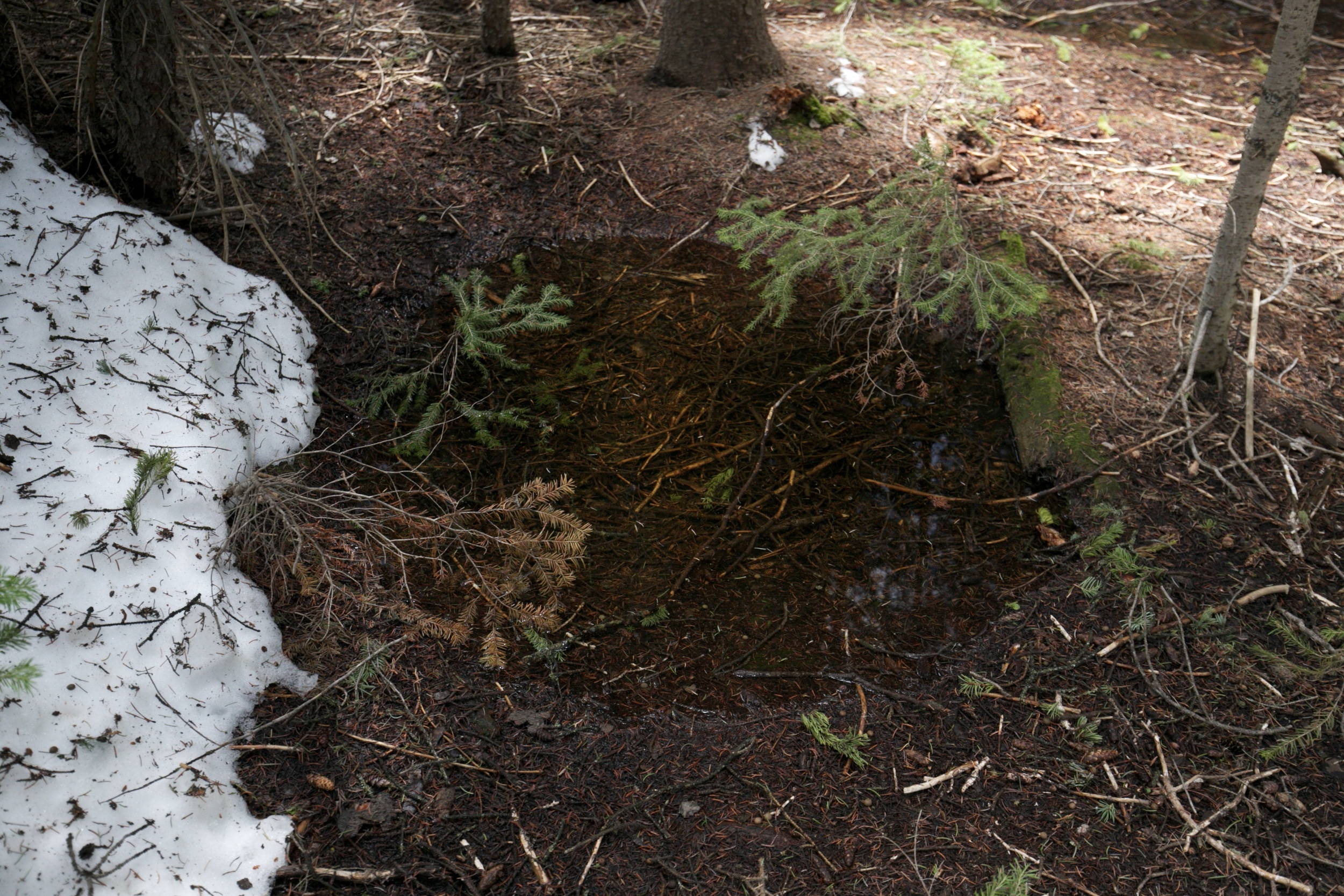
Dripping water in a mossy ice cave.
Still pond in a pine forest.
Mushroom amongst pine needles in a forest.
Independence Pass in winter, Colorado.
Trees growing in the cracks of a grotto.
The Grotto ice caves, with ice formations, Independence Pass, Colorado.
The grottos, with blue ice and rock formations.
Ice waterfall in a cave - the Grottos of Independence Pass, Colorado.

THE RAILYARDS

A wall of broken glass, at the Rail Yards, an abandoned place in Albuquerque.

no market today
no

instead we sneak
like mice amongst millet
looking for pleasures
we aren't supposed to find

A cop rounds the corner
of the chain-link
and we duck down to dusty concrete

but high up on the roof
and along iron rafters
there is no fear of capture
only of falling
which is actually
closer to elation

I pause, alone now,
kicking at the wooden blocks
that spill out of the floor
and gazing upwards to green glass windows
trying to hear the trains


At The Rail Yards in Albuquerque.
The Rail Yards - a beautiful abandoned complex of buildings in Albuquerque
Standing in a giant doorway, the Rail Yards.
Colourful graffiti at the Rail Yards.
An abandoned building - part of the old Rail Yards.
Pillars and graffiti inside the Rail Yards.
Glass windows at the Rail Yards.
Two doves sit in broken windows, between graffiti at the Rail Yards.
Climbing to the roof of an abandoned building.
On the roof at the Rail Yards with trains passing by.
Looking down at the abandoned railway building in Albuquerque
An old filing cabinet at the Rail Yards in Albuquerque.