THE GRAND CANYON

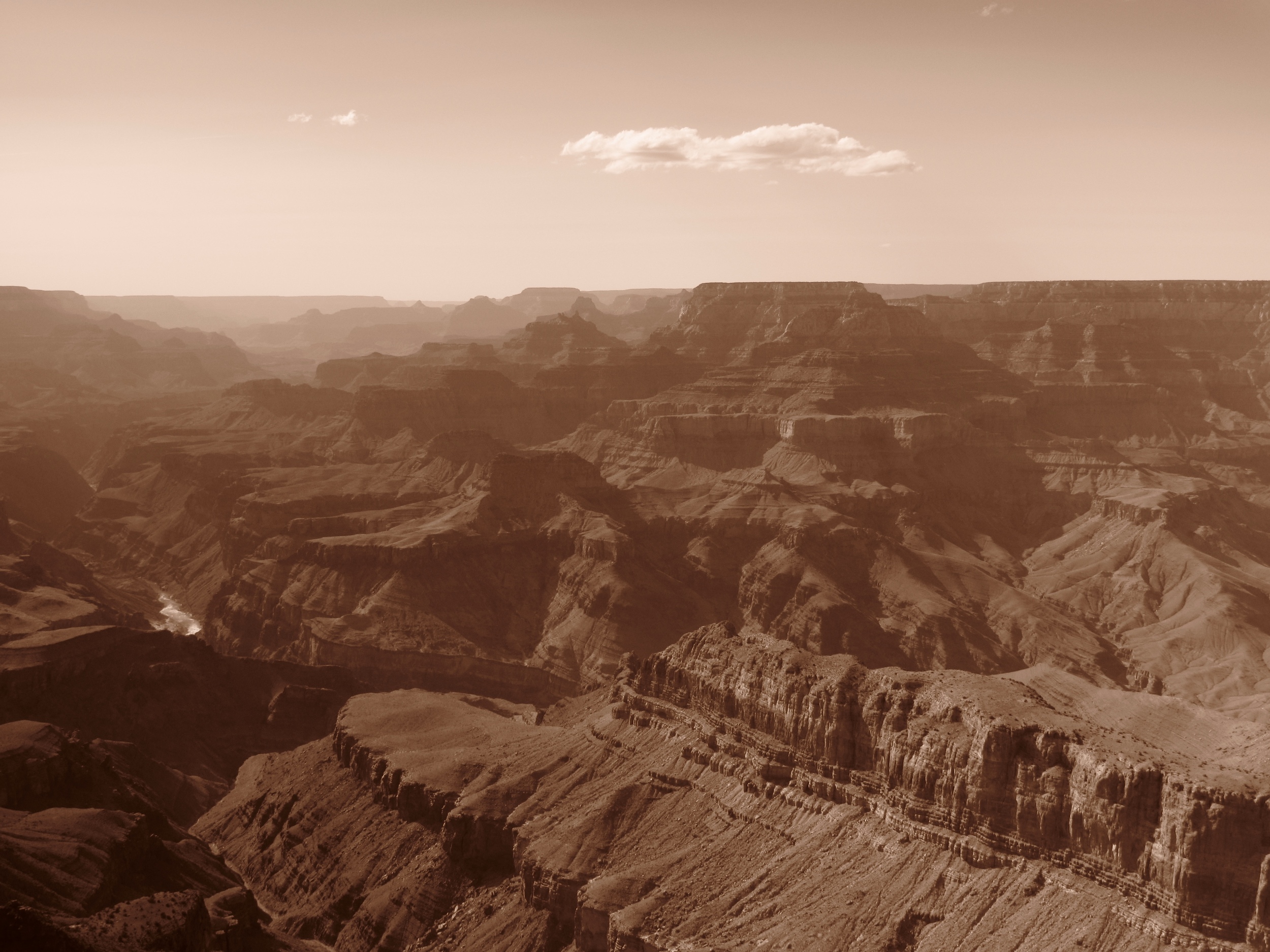
The Grand Canyon, in black and white.
In the Southwest, canyons are assertive landscapes. Aridity sharpens their bones. Rivers may run through them—open arteries in a carapace of rock; others flow only with blow-sand and chokestones. Canyons come blind, box, side, slot, hidden. They stair down and pour off. They gooseneck. They hang. Muley Twist, Desolation, Snap, Lavender, Blue Canyon, Rain Canyon— canyons are where you want to live merely on behalf of their names. The Hopi word pösövi means “canyon corners,” as if one quirky, prismatic facet at a time were all you could manage in this seemingly irrational geography of space and rock.
— ELLEN MELOY - HOME GROUND

GRANDER THAN WE

A pillar of stone drifts on the edge of the canyon about a meter from the edge. It tempts any stray adventurers, who contemplate jumping over that void to become a lonesome star inhabiting an island on top of the world.
Oliver jumped across the gap, and my heart caught in my throat a little. But I stayed put, legs swinging over the edge of my solitary perch, wind whipped hair caught in my mouth, eyes and tangled into a frenzy. It was windier than I had imagined it would be. The canyon exceeded my expectations in other ways too; the size of the canyon being almost incomprehensible.
At one point, the cliffs of the opposite rim looked so close, reachable, maybe, if one was to leap off the edge and take flight.
Then I was astounded to learn that these cliffs were over 50 km away. It was like the distortion one sees in a car mirror but this time it would read:

OBJECTS IN CANYON ARE FURTHER THAN THEY APPEAR

The landscape was teaching me perspective.
Me: a tiny being sitting on a precipice and swinging my feet above a mile of thin air.
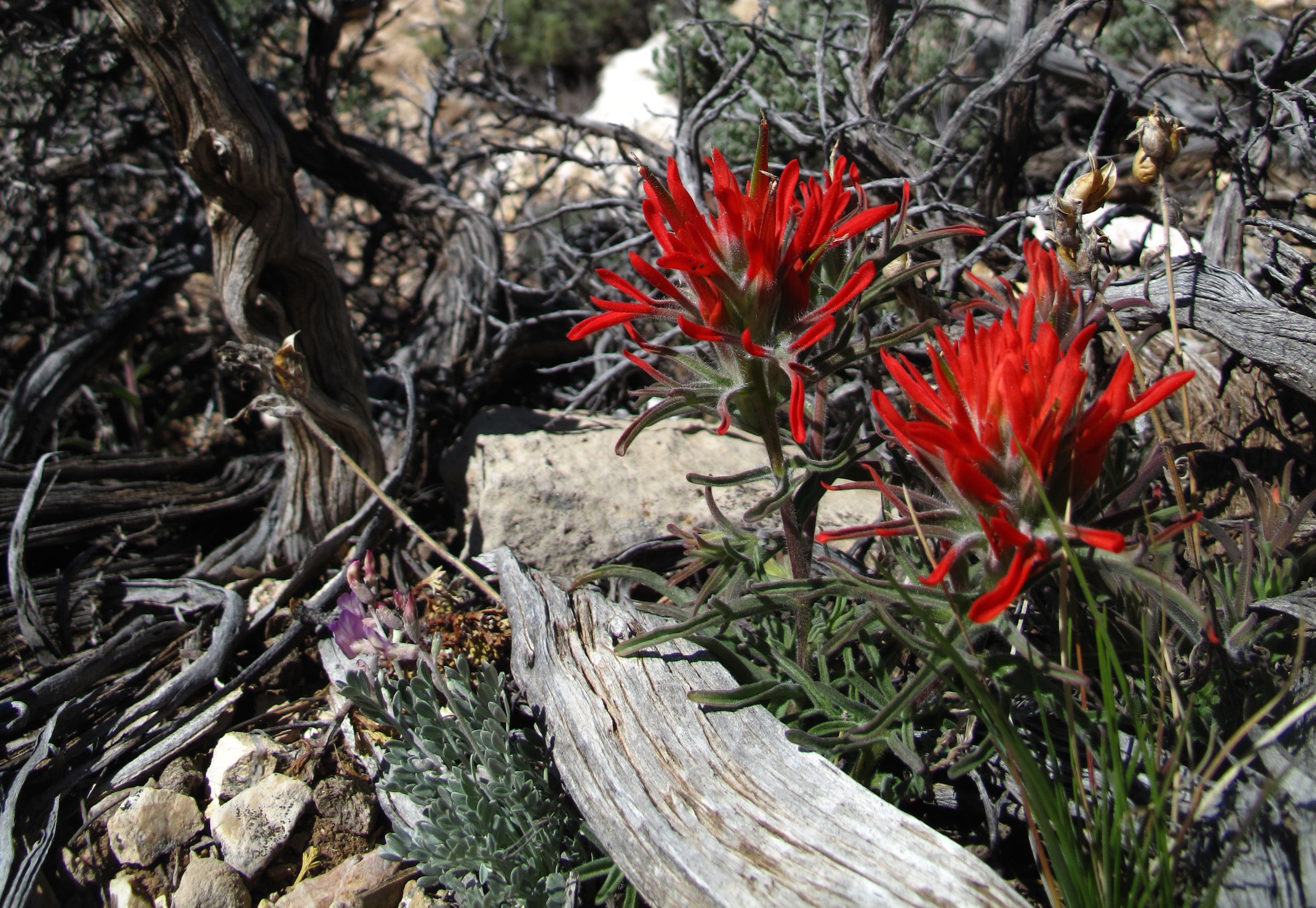
The canyon: endless space, rock points, facets, small patches of red desert Indian paintbrush growing in a crevasse, wind, warmth, loss of heat at the end of the day, heat gained while walking down into the Earth, rivers, animals, first peoples, a billion insects, the changing seasons, an ongoing process of millions of years of erosion. 

SHIFTS IN PERSPECTIVE

The canyon is undeniably beautiful. Words fail even the best of us when it comes to describing the canyon. But look past the initial shock, and the aesthetic value of the scene. What can we learn from the canyon? How might we learn these lessons?

The canyon teaches resident artists the value of colour, the way it changes from day to day, season to season. It teaches the ecologists the value of life, of land, of resources to support its growth - pockets of plants existing uniquely, atmospheres changing rapidly from one altitude to the next. Miniscule moments, morning noon and night, the days, the years, the bees, the flowers, those rocks we now see on the eroded walls, these are all studies on the human level.

Then there are those things we are unable to know. No person will live long enough to study the lifespan of the canyon, nor learn firsthand the bigger lessons it has to teach: of creation, erosion, formation, shape, gradual compaction, of the ancient world and seas, and of a distant future that exists within its very walls the way it does not exist within me.

What I learnt was humility. The canyon exists even if I do not. Life goes on, buzzing in each corner, in each moment, for longer than I can even imagine. It tells me there is something grander, something of which we are only a infinitesimal part. And that was truly humbling. 


Sitting on the edge of the Grand Canyon.
The Grand Canyon in the late afternoon - blue skies and shadows.
Oliver looking through a telescope at the Grand Canyon.
Spring at the Grand Canyon - red desert flowers.
The Grand Canyon ledge.
The Grand Canyon in black and white.
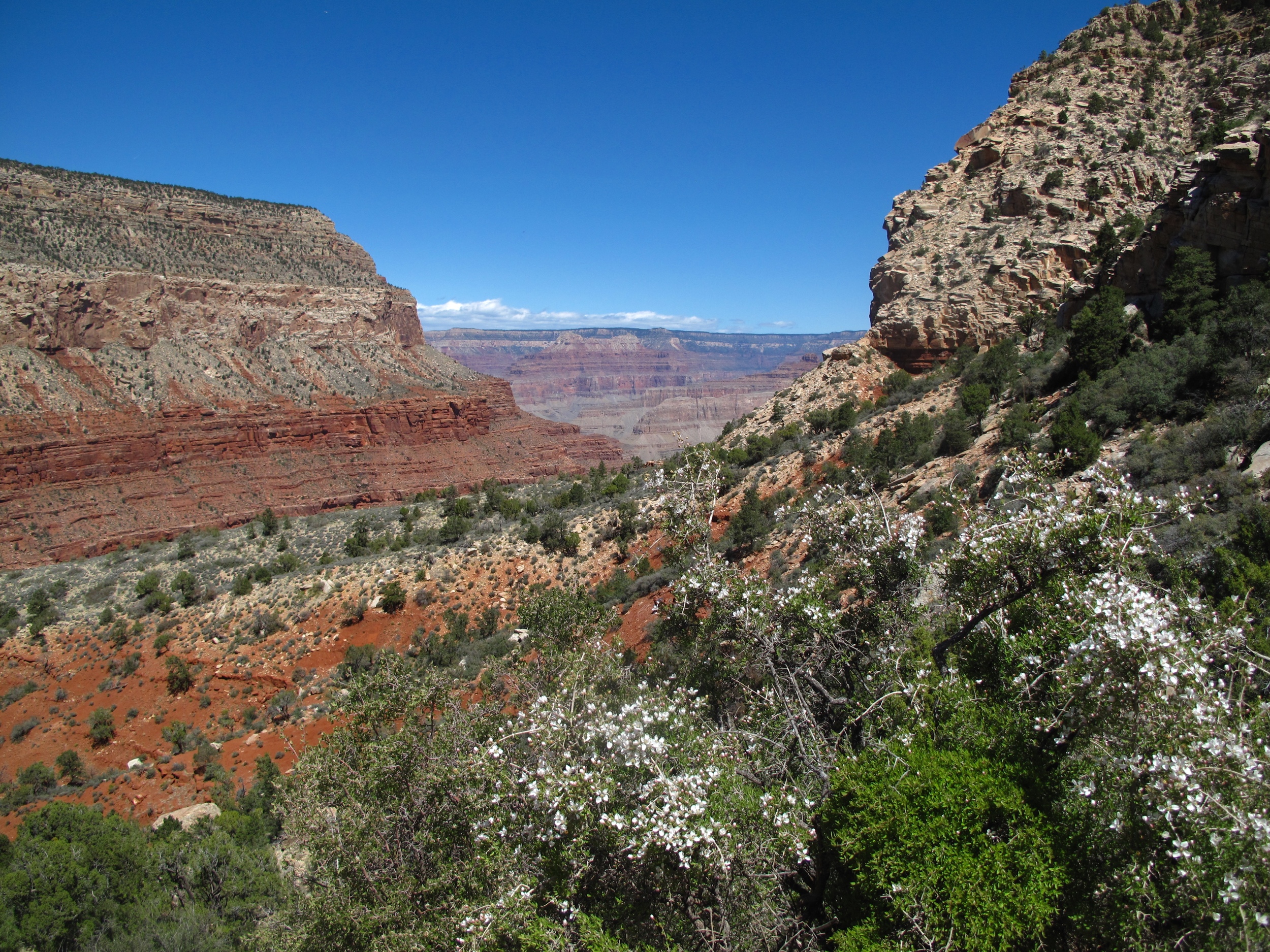
Walking the rough Hermit Trail into the Grand Canyon.
Oliver standing on a pinnacle at the Grand Canyon.
Red and purple desert flowers in the Grand Canyon in spring time.
Red walls of the Grand Canyon at sunset.
Sunset at the Grand Canyon - pink hues.

ARCHES OF MOAB

Landscape Arch at sunset in the Arches National Park, Utah.
 

DRY BONE BARITONES

I will always remember that scene in Picnic at Hanging Rock, when the four young girls, dressed in frilly white frocks, break away from the party and climb up the rock face. They are slowly overcome by fatigue, and at some point the rock begins to hum - the kind of low vibration that makes hairs stand up on the back of one's neck. The kind of low vibration that occurs when wind is trapped in high places; eery, mystical, somewhat scary. 

A group of Scientists studying the arches of Utah's national parks have recently found that the arches are humming. 

While conducting research on the health of the arches, and trying to determine when and why individual arches may fall down, the team found that they were able to measure the vibrations of the arches as they moved in the wind. By studying these vibrations, they could then assess the internal structures, movements and overall health of each arch. 

Reading about this, I was struck by the feeling of an instantaneous meshing of my experiences and scientific fact. I had often felt the humming of larger rocks, the way one can hear a TV being switched on in the next room. It is at once a knowing, and a physical sensing of the thing. 

According to these scientists, the rocks are not only humming, they are also moving, being plucked by the wind like strings of a cello. 


EARTH

AIR &

WATER

Millions of years of Earth time and Earth water create a natural arch, rib bone of Earth—red sandstone, pale limestone, dark basalt—by flaking small pieces of rock off a slender wall until a hole finally forms. Water, the agent of erosion, dissolves the rock and gathers in its small cracks and fractures, freezing and expanding, loosening rock grains sometimes too small to see. Arches are Earth clean to the bone. A person walking through one walks through Time. Land arches are most common in the Southwest, particularly in the Utah canyonlands and the Four Corners area. Sea arches occur in coastal bluffs, where it’s the constant pounding of ocean waves that wears a hole through a promontory wall. Natural bridges are a type of arch, but they are created in a different way. Instead of rainwater and snowmelt, it’s the current of a stream or river that eventually cuts a hole in the rock.
— LINDA HOGAN - HOME GROUND
 
The Courthouse Towers seen through a dry twisted tree, Arches National Park, Utah.
Balanced Rock - with desert flowers, in Arches National Park, Utah.
Sitting on a rock in front of the Courthouse Towers, in Arches National Park.
Road through the Arches National Park, Utah.
Long haired girl explorer in Arches National Park.

the bones of the Earth laid bare
move with the frequencies
of air

- an intimate connection
between the two.

and me
standing there
in the gaping chasm that separates my foreign consciousness
from my ancient new home
listening in on the conversation
trying to make sense of a language I do not speak
catching only the faintest hints of those words
that hold a common root
and yet, acutely aware of the gist of it all.


Spiny desert plants in the Arches National Park.
Windows arches in the national park, Utah.
Dry desert tree and sand, Utah.
Navajo Arch, Arches National Park, Utah.
Arches National Park Devil's Garden arches.
Small desert tree in Arches National Park at sunset.
Holes bored into the red rock by water, Utah national park.
Devils Garden at sunset and twisted tree silhouette's, Utah.
Sitting on top of Arches National Park ledge, looking over the park.

ORCA

Bird flying over the sea by the San Juan islands, USA.

SENTIMENT | SENTIENT

FEELING | EMOTION | EXPRESSION | CREATIVITY


Far into the distance a flume of water evaporated against the sun; a temporary rainbow sparkling inside a cloud. And then again. And now, only a few hundred meters from the boat, she broke the surface and, in an instant, cartwheeled through the air, creating the most spectacular sight I have ever seen. A small child on the boat cried out, with the utmost sincerity, "What a magnificent creature!" I could feel it too: the allure of the Orcas, and their presence. People had gathered along the shoreline to watch the Orcas pass, and every noise seemed to be drowned in an unwavering sea of connection linking me to the scene as I watched. They hugged the shoreline, searching for the early season Chinook salmon. At one point, a young Orca lifted itself slowly out of the ocean belly first, turning itself to reveal the gleaming black and white pattern of its body before slapping through the surface. The word mesmerising does not even begin to describe it. 

Many belief systems see the ocean as the source of all life, including our commonly held Evolutionary paradigm. Some indigenous groups of the Americas believe that Orcas are guardians of heritage, holding within them a spark of the original creative source. Watching an Orca from a boat, seeing that gentle spray of their spout and the deep inhale they take before a dive, may also teach us the power of the breath - of respiration - an important resource of life on Earth.


je respire
...I breath...


Those scientists who have studied Orca will also attest to their creative nature, in the form of play. Orcas exhibit playful behaviours that are seemingly unlinked to their practical ones, behaviours such as breachingspyhopping, and tail slaps. When two pods of Orca meet after a long time apart, they will undertake a kind of greeting ritual, in which the two groups face one another and slowly merge until they are intermingled. While this is happening, they will vocalise and express their excitement through playful behaviour. 

This kind of social interaction is not unusual for Orcas, as they are highly social and sentient creatures. Studies have shown that the part of an Orcas brain relating to social thoughts and feelings is relatively larger than that of a humans, and thus their social bonds may be even stronger. It has even been noted that the Orcas of the Southern Resident Community work within a matriarchal social system - both male and female offspring stay with their mothers the entirety of their lives. 


j'appartiens
...I belong...


Perhaps these are the reasons we feel so sad when we see an Orca in captivity. To capture an Orca, to take it out of its habitat and away from its family, is to oppress its natural creativity and social feelings. Conversely, an Orca in the wild is a reminder of the pure and powerful forces of creativity, expression and feeling. 


je me souviens de se sentir
...I am reminded to feel...


Life saver on the ferry to the San Juan islands, near Seattle.
Nicole's hair blowing in the wind as we sail along the coast in the San Juans.
Humpback whale near the San Juan islands.
Baby orca doing a half breach, along the coast of the San Juan islands.
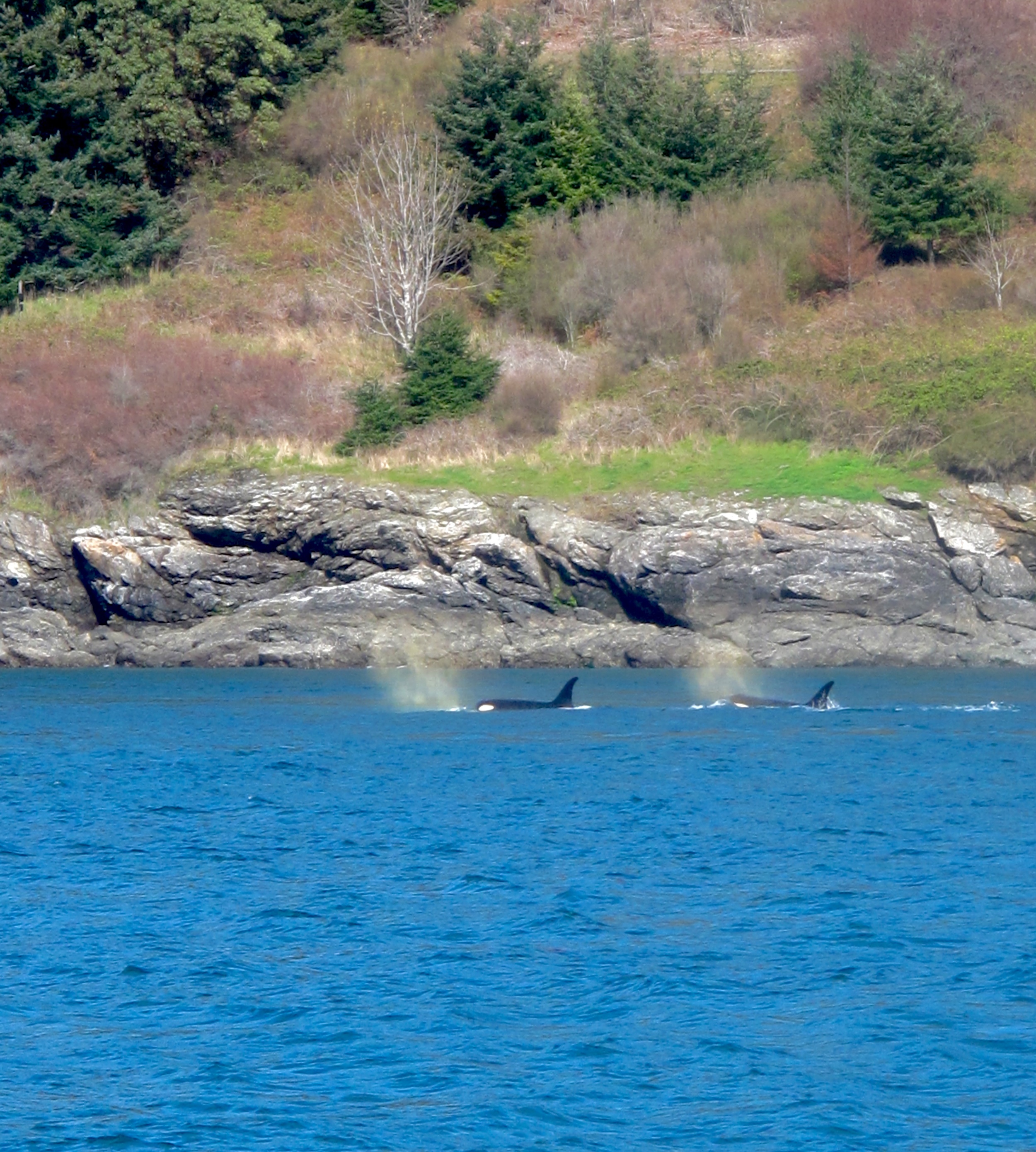
Two Orcas spouting sea water in plumes by the coast.
Looking at the sea through a telescope.
Beautiful green and lush alpine islands in the San Juan area.
Swathes of clouds in the sky, on a sunny day in the San Juan islands.
Huge male orca with a fin the size of a small boat!