THE BLACK FOREST

A sleeping beauty in the forest in a bed of leaves
The grove is the center of their whole religion. It is regarded as the cradle of their people, and the dwelling place of the supreme God to whom all things are subject and obedient.
— TACITUS - GERMANIA c. 98 A.D.

Enter the forest.

Setting of so many folk tales and legends. Of Hansels, Gretels, witches, wolves, woodcutters, enchantresses, and sleeping beauties. 

Woven through these tales, the forest has its own persona. One veiled in mystery - the forest hides its secrets well, revealing them only onto the select few: a small cottage among the trees, a commune of dwarves, or a riverbank of red berries ripe for the taking. But then the trees grow close again.

The forest speaks in whispers, in the tongues of leaves and creeks. 

Gretel in the Black Forest
Black Forest in Germany - light through the trees.
Witch's cottage in the Black Forest.
Witch's potion ingredients inside her cottage
Mushrooms growing wild in the Black Forest
The Black Forest of Germany - a cabin in the woods.
The Big Bad Wolf sleeping in Grandma's cottage in the woods.

In the evening they came to a large forest, and they were so weary with sorrow and hunger and the long walk, that they lay down in a hollow tree and fell asleep.
The next day when they awoke, the sun was already high in the sky, and shone down hot into the tree. Then the brother said, "Sister, I am thirsty; if I knew of a little brook I would go and take a drink; I think I hear one running." The brother got up and took the little sister by the hand, and they set off to find the brook.
But their wicked stepmother was a witch, and had seen how the two children had run away, and had crept after them stealthily. as witches do creep, and had bewitched all the brooks in the forest. 
Now they found a little brook leaping brightly over the stones, the brother was going to drink out of it, but the sister heard how it sang as it ran. "Whoever drinks of me will become a tiger." Then the sister cried, "Pray, dear brother, do not drink, or you will become a wild beast, and tear me to pieces."
The brother did not drink. although he was so thirsty, but said, "I will wait for the next spring."
When they came to the next brook the sister heard this also say, "Whoever drinks of me will become a wolf." Then the sister cried out, "Pray, dear brother, do not drink, or you will become a wolf, and devour me."
The brother did not drink, and said, "I will wait until we come to the next spring, but then I must drink, say what you like; for my thirst is too great."
And when they came to the third brook the sister heard how it said as it ran, "Whoever drinks of me will become a deer." The sister said, "Oh, I pray you, dear brother, do not drink, or you will become a deer, and run away from me." But the brother had knelt down at once by the brook, and had bent down and drunk some of the water, and as soon as the first drops touched his lips he lay there a young deer. 
And now the sister wept over the poor bewitched brother, and the little deer wept also. But at last the girl said, "Be quiet, dear little fawn, I will never leave you." She plucked reeds and wove them into a soft cord. With this she tied the little beast and led it on, and walked deeper and deeper into the forest.
And when they had gone a very long way they came at last to a little house, and the girl looked in; and as it was empty, she thought, "We can stay here and live." Then she sought for leaves and moss to make a soft bed for the fawn; and every morning she went out and gathered roots and berries and nuts for herself, and brought tender grass for the fawn. In the evening, when the sister was tired, and had said her prayer, she laid her head upon the fawn's back: that was her pillow, and she slept softly on it. 
For some time they were alone like this in the wilderness. But it happened that the King of the country held a great hunt in the forest...


an extract from:
THE BROTHERS GRIMM - LITTLE BROTHER & LITTLE SISTER


Castle on the hill - Hohenzollern Castle in Germany.
Sleeping Beauty's castle - frog holding a crystal ball at the gates.
Wishing well in the Black Forest
Snow White apple in the Black Forest
Hohenzollern Castle - a fairytale German castle on a hilltop.

WITTENBERG

Canals through the old town of Wittenberg, with bicycles and flower baskets.
Wittenberg town square, and markets selling fresh produce.

CHANGE & CONTINUITY


We wandered down cobbled rows, and past the castle church where Martin Luther is buried. The only sounds were the clicking of bike spokes and the jumpy-rusty noises as the bikes juddered along the stones. No cars, just bikes, and plenty of them.

It was hard to imagine that sleepy old town as the center of our modern western world...

CHANGE

In the 16th century, things were heating up. Theologians over Europe had begun to read classical texts in their original scripts and languages, foregoing the later Latin versions. They found errors in the later versions, and fixed them. Some people even began to read the Bible this way, and found that it had been tampered with over the years! 

Moreover, theologians were beginning to feel a dissatisfaction with the ways of the Catholic Church. There was a lot of corruption - practices such as 'simony,' (the selling of ecclesiastical offices, or the patriarchal inheritance of an office). Moreover, the bishops inheriting their titles from their families were not all that educated in matters of theology, and oftentimes they would preach a garbled version of the Bible. They also loved to take mistresses, and it was widely known that many bishops and priests had sired illegitimate sons and daughters. Yet, they were not allowed to marry. On top of all this, taxes were being raised by the church through "indulgences" - letters of pardon that allowed access to heaven. These were sold in a frightening manner, with clergymen scaring the wits out of people by putting their hands in flames and proclaiming messages about hell. People then bought indulgences, after seeing the very burnt hands. Yet, they did not attend church as they should, because they had bought their pardons.

These goings on upset one small German monk by the name of Martin Luther. Far, far away from Rome, he wrote out his grievances and stuck them to the doors of the local church. Normally, these grievances would simply be discussed by the local theologians and philosophers, and there it would end. But, there was a new element at play...

The invention of the printing press had turned the publishing business on it's head. Where books once had to be scribed by hand, and cost a fortune, they were now scribed by machines - lessening the time and cost it took to produce each volume. Changes happened rapidly - the market for the printed word, which had almost solely been occupied by theological works, was now flooded with stories, folktales, novels and pamphlets on every topic under the sun! In this environment, Luther's grievances about the church were taken up, printed and spread like wildfire! The cry went up in Rome, and the drawbridges came down. There was a schism like never before, and the world changed...

Martin Luther changed our attitudes and our ways of seeing the world quite unwittingly. By calling for a Bible in everyday language, he allowed the layperson to read and interpret the Bible for themselves. He had thought that the interpretation was clear, but each person had something new to say. Thus, the reformation spread, and the numbers of Christian denominations grew. Where the western world was once united under the name "Christendom," it grew to hold the 32,000 denominations of Christianity we have today. Alongside these changes grew the ideas of religious tolerance, of nation-states and national citizenships. Each nation was able to choose for itself, to mould its own citizens in belief and to bring them together under that banner. More importantly, Luther had opened up religion, making it much less organised and much more personal - emphasising the individual's relationship with God. Heterogeneity was 'in,' there were suddenly choices to be made, and thus was born our modern world of individualism, choice and informed opinion.

CONTINUITY

Change is inevitable, and impermanence is truth, but there will always be some elements of continuity throughout history - those threads that we still find meaningful, and so we preserve them, weaving them back into our current social fabric. And so we may talk of history, not as the march of progress, but as a complex web of dynamic elements. 


Wittenberg was the perfect example of this. 


BEAUTIFUL CONTINUITIES

Bicycles with baskets.
A market selling fresh produce in the villages square...

Lettuces, apples, peaches, and honey.
Water gurgling in the canals that run beside the cobbled streets.
Old men sitting in the bier-gardens at noon.
The well-preserved house of Martin Luther, complete with medieval tower.
The walls, ceiling and floor of the living room are all original, undisturbed. On the door is an initial, carved there by the Csar of Russia on a visit. 
The paint is flaking and the floorboards are rotting and musty, but it was there that I felt a thread of time truly connecting me to a personage of the past... 'he really did live here.' 
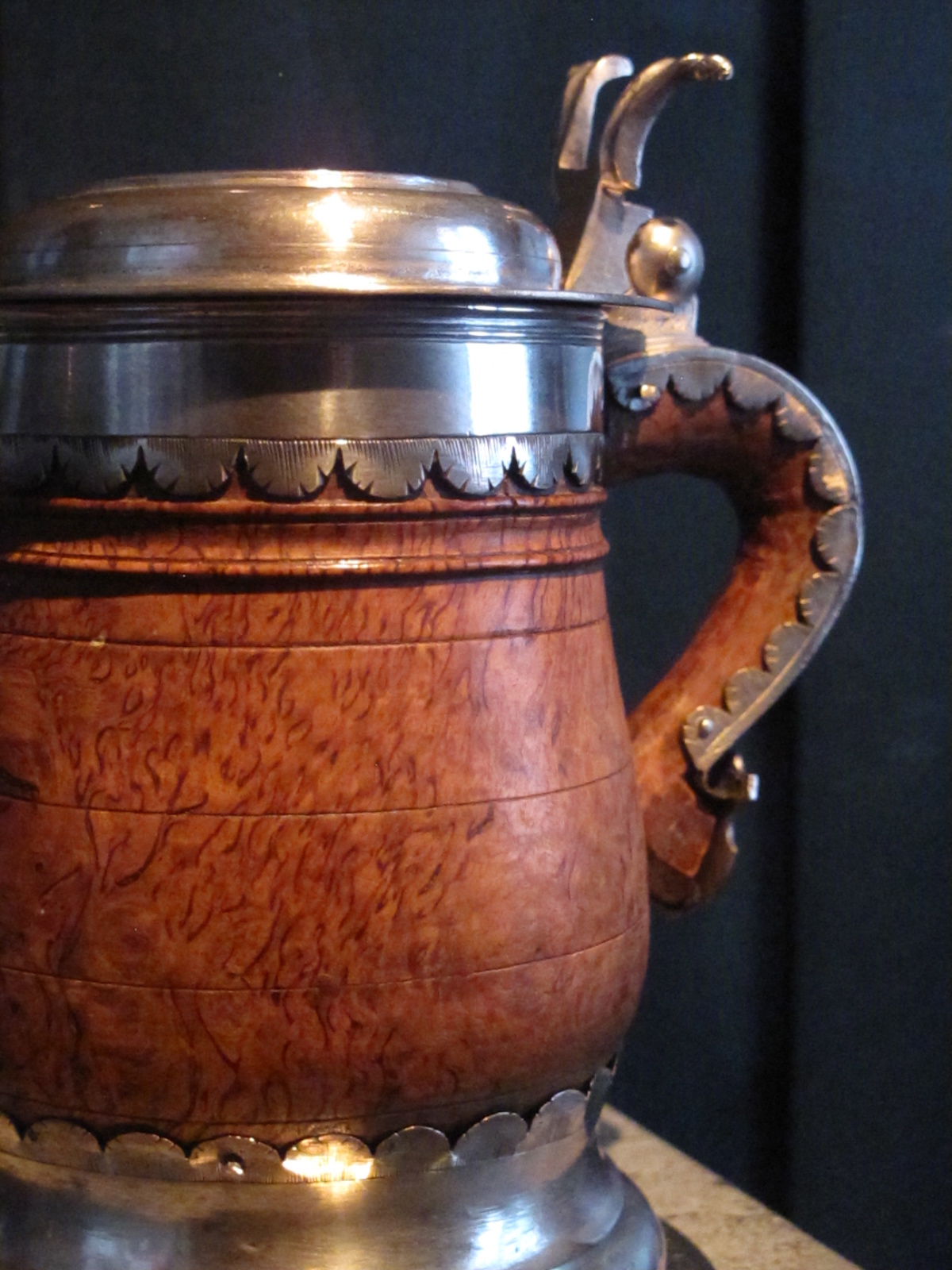
Martin Luther's beer mug.
The 'Weinfest' that had gathered together merry locals in the village square for wine, dancing, traditional costumes, and the naming of a 'wine princess.' 
There was much hulla-balooing as a regiment of medieval-clad men marched around the town to the sound of trumpets and clanking weaponry.
A long speech by the local pastor, who was looking very à la mode in his Luther-esque black robes and cap.
A traditional pizza-like bread called Flammkuchen, cooked in an earth oven till crispy, then slathered in a creamy cheese and spring onions. 
Wine, and lots of it! Plum wines, aromatic vanilla wines, sweeter wines made of mango, and of course the ubiquitous grape wines. 
The moon will wax, the moon will wane,
The mist and cloud will turn to rain,
The rain to mist and cloud again.
— HENRY WADSWORTH LONGFELLOW
A wreath of flowers on a door in Wittenberg
Bicycle and long shadows of the bicycle in the afternoon, Wittenberg.
A sign covered in flowers in Wittenberg
Martin Luther's house in Wittenberg - the tower.
Martin Luther's room Wittenberg
Martin Luther's beer mug, in the Luther House Museum, Wittenberg.
Spring wreath at the Weinfest in Wittenberg
Guards at the Weinfest in Wittenberg, dressed in medieval costume.
Flammkuchen - like a German pizza bread.
Drinking local German sweet wines at the Weinfest in Wittenberg.
Sunset near Wittenberg, with a lake and tree silhouettes. 
She saw her sitting with her son in the window and the cloud moving and the tree bending, how life, from being made up of little separate incidents which one lived one by one, became curled and whole like a wave which bore one up and threw one down with it, there, with a dash on the beach.
— VIRGINIA WOOLF

ELISABETH SANATORIUM

Elisabeth sanatorium, Berlin Abandoned places.


I'm not sure why I am drawn to abandoned buildings. My friends would answer that with the quip:


you like the sense of danger and adventure,


and sure, they would be right. But it is something else too - the historian in me, perhaps, trying to peel back the layers of history to glimpse something real. There is an ocean-sized gap between the polished façades of a restored heritage building, and one that has been neglected and stripped and left to rot. One is beautiful in its splendor, but the other has a haunting authenticity.

An abandoned building is like a reminder to me that people really did live their lives, as human as-could-be, even a hundred or more years ago. The visible remnants bring me to this epiphany. And then I feel more than my historian logic, I feel my historian heart beating in time to the lives of others whom I will never meet nor truly understand. 

Besides, there is always the sense of danger and adventure! 


FLUTTERING CURTAINS

Elisabeth Sanatorium was the perfect place to go looking for the dangerous adventures that my heart yearns for; a 1912 brick structure masquerading as an impressive stone mansion; the farce visible through peeling walls. There are rumours of a guard, although these may be unfounded. We entered by stealth. 

But one's feelings of heightened awareness, bordering on anxiety, do not subside once indoors. No, in there, the mood is hung on the air like laundry. It is cold, doors are open, expectant. And sometimes a noise will come from another corner of the building, in a far-off ward. The place used to be used as a TB treatment center, then later as a skin clinic. The atmosphere is, overall, lachrymose. 


I felt as if I was capturing photos of another's artwork, my own photography being a simple homage to the original.


Oliver sneaking into an abandoned place in Berlin.
Doorway inside Elisabeth Sanatorium, with peeling wall paint and old tiles.
Curved staircase inside the abandoned Elisabeth Sanatorium, Berlin.
Old peeling wallpaper with a retro design, inside the Elisabeth Sanatorium
Curtains fluttering in the wind - with a 60's orange flower pattern, Elisabeth Sanatorium
Window and fluttering curtains inside a dark room of an abandoned sanatorium, Berlin
Shattered picture frame and dried flowers inside the old Elisabeth Sanatorium
Station II - wards inside Elisabeth Sanatorium
A dark room and a chair inside an abandoned sanatorium.